Online thoughts, offline deeds
Anti-Semitism and the Israeli-Palestinian conflict

As the far-right increasingly looks for ways to gain legitimacy, current events have, and will continue to, provide opportunities for extremist groups to reframe old narratives. The Bundesamt für Verfassungsschutz has labelled groups within Germany looking to bridge the gap between extremism and legitimacy as the “New Right.” This term was originally applied to a far-right political movement which was founded in the late 1960s, as the “Nouvelle Droite.” Today, the renewed trend of the “New Right”, present throughout the world, has been a principal reason for the growing appeal of far-right groups. Last year, in May 2021, the escalation in violence of the ongoing Israel-Palestine conflict provided an opportunity for extremist groups to co-opt mainstream narratives about Israeli aggression to spread anti-Semitic hate, likely inspiring anti-Semitic attacks.
On Telegram, a platform which has notoriously failed to take adequate steps to counter extremist content amongst its users, far-right channels have used this newly formed, wide user base to spread anti-Semitic hate throughout the Covid-19 pandemic. The link between online hate and offline anti-Semitic hate crime is real and so, as the pervasiveness of anti-Semitic rhetoric has increased online, so too has the threat to the Jewish community offline.
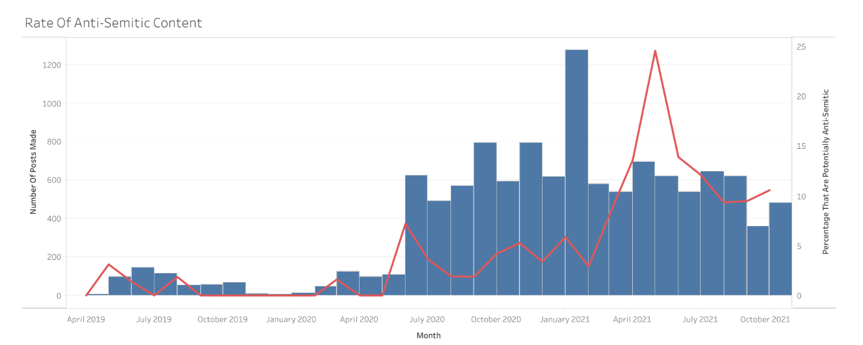
The far-right often manipulate popular discourse and current events to spread their own extremist narratives. One notable example of this in 2021 was the peak in fighting between Palestine and Israel, which coincided with increases in both online extremist content as well as violent acts towards the Jewish community. The below graph shows the number of posts from five far-right North American Telegram channels since 2019, as well as the percentage of these posts likely to be anti-Semitic. There is a striking increase in May 2021, when this percentage reached almost 25%, coinciding with the intensification in the Middle East conflict.
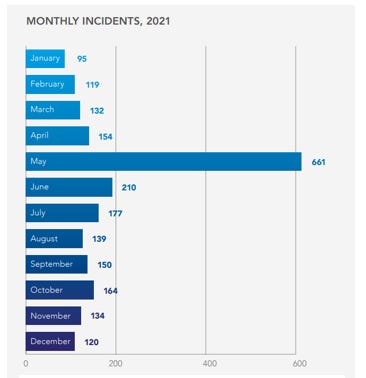
The Community Security Trust (CST), a UK charity dedicated to tackling racism, and anti-Semitism in particular, found that there were 2,255 anti-Semitic incidents in the UK in 2021. This number is the highest recorded in a calendar year. Furthermore, it found that this record was “due to the volume of anti-Jewish reactions to the escalation of conflict in Israel and Palestine”, evidenced by the fact that nearly 30% of the total incidents in 2021 occurred in May. These statistics prompted John Mann, the government’s independent adviser on anti-Semitism to state that it was time to “reconsider efforts to tackle anti-Semitism”.
If governments in North America and Europe are to successfully tackle this spike in anti-Semitic violence, they must focus their efforts on stemming the rise of online hate too. This is made more difficult by the shift towards alternative media platforms such as Telegram and Gettr, which are both harder to track and to regulate. Future research could adopt a more granular, qualitative approach to exploring the ways in which events in the news trigger more anti-Semitism online, so that far-right narratives can be identified and more easily countered.