A new chapter for the RN
After its record electoral gain in June 2022, how will the Rassemblement National adapt to its new role in & outside the establishment?

In the second round of the French legislative elections on 19 June 2022, the populist radical right (PRR) party Rassemblement National (RN) won a record 89 seats in France’s National Assembly (the lower house of parliament). This made the RN the second largest party in parliament, after President Emmanuel Macron’s party Renaissance (renamed thus from La République en Marche in May 2022). Even though the left-wing coalition movement NUPES won 151 seats, the largest political party within the coalition, Jean-Luc Mélenchon’s La France Insoumise, only won 75 seats, placing it behind the RN. The RN’s result presents a new chapter for the party, which until recently only had 8 seats in parliament, and which has not had more than 32 seats in its history (elected under a different electoral system in 1986).
How will the RN, up until now a political outsider, adapt to its newfound influence in the National Assembly? Will being perceived as part of the establishment lose it support from its followers? It is, of course, still very early days to judge the party on its policy achievements. However, existing academic literature on other PRR parties’ participation in government (in Austria, Italy, Switzerland etc) can help indicate what impact the RN’s might have. The RN’s Facebook posts from the last month can also tell us a lot about their tweaked media strategy and supporters’ reactions. There are three main factors drawn from literature which will be important to the RN: keeping control over their policy agenda, being well-organised, and maintaining their ‘outsider’ image (Zaslove, 2012).
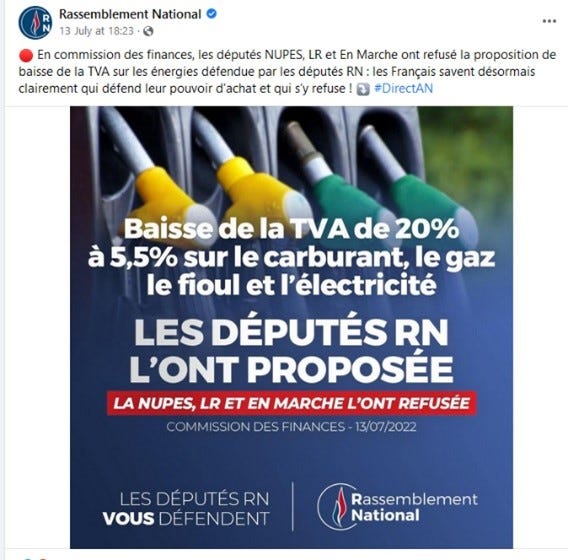
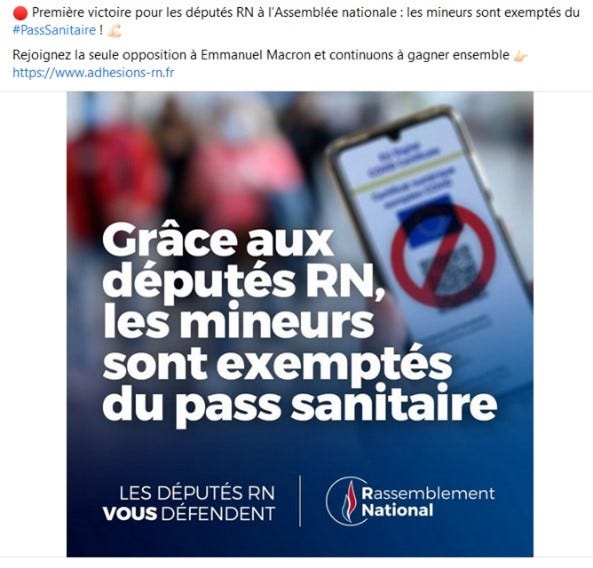
It goes without saying that voters judge parties on the extent to which they have kept their policy promises (Akkerman & de Lange, 2012). In the PRR context, these policy promises are usually along the lines of the parties’ core ideological points: immigration, law and order, and the economy. As the PRR are usually the weaker, minority partner in government, their motions are often voted down, or if relevant legislation is voted through, their contribution can be overlooked (for example, if the PRR is working with a centre-right partner, the latter might also be enthusiastic about anti-immigration legislation). So far, the RN has kept clear control over their policy agenda, with regular media appearances and speeches in the National Assembly on lowering VAT (TVA) on energy, the restitution of healthcare staff who were suspended over their refusal to get a Covid-19 vaccination, and stricter application of French expulsion measures (OQTF – obligation to leave French territory). On Facebook, when favourable legislation is passed, the RN presents it as a victory which it is solely responsible for, and when RN proposals are voted down by the other parties, as with a proposal to lower VAT on gas, fuel, and electricity, the RN also highlights this, as proof that the RN is the only party ‘defending’ the French people. This ties it to issues which are important to its voters.
In addition, the second factor that existing literature considers contributes to a PRR’s success in government is good internal organisation, coherence, and lack of tensions (Fallend, 2004). This is another factor in the RN’s favour, with the party centralised around the figure of Marine Le Pen since 2011. Although Jordan Bardella is head of the party, Le Pen is head of the party’s parliamentary group, and even Bardella conceded in a speech on 23 June that the party’s victory should be attributed to Le Pen. Facebook posts since the results of the legislative elections have largely focused on the party’s key figureheads, with images of Marine Le Pen greeting newly-elected deputies, and reporting on party meetings led by her.

The final criteria which will be crucial to the RN’s success is ‘keeping one foot in government and one foot out’ (Albertazzi & McDonnell, 2005). As indicated above, the RN is continuing to emphasise that it is the only party defending the interests of French people. The party is also insisting on its ‘outsider’ image by claiming to be the ‘only’ opposition force against Macron, which NUPES deputies would likely disagree with.
Jordan Bardella, in a speech on 23 June, also re-emphasised that the RN deputies ‘will retain the close link to the people forged during their campaigns’ during their mandates, in line with the party’s populist roots.

However, the RN is treading a fine line, as being seen as too much of an outsider would risk alienating possible new voters from the centre right, notably from the right-wing Les Républicains (LR). One post from 30 June calls on LR voters to join the RN ‘in the face of the betrayals of the right.’ Furthermore, while comments on the Facebook posts of the party’s official page are largely positive, the RN’s increased influence and power, and a perceived failure to act on it, has led to discontent from some. Notably, supporters criticise the RN’s refusal to vote in favour of the NUPES’s motion of no confidence in the government of Prime Minister Elisabeth Borne on 11 July. In addition, predictably, the RN used the revelation of the so-called Uber Files, showing that Macron went to great lengths to support Uber while economy minister in 2014-2016, to criticise Macron, but some supporters commented that they were ‘disappointed’ as the RN was now ‘complicit’ in his government.
Although the comments on the Facebook posts of the RN show clearly that the party’s supporters have great expectations for it, with many asking the RN not to ‘forget the people who voted for you’ and to ‘act and show what you promised us’, the three criteria which have contributed the success of the PRR in government in other countries (e.g., Italy) are present in the case of the RN for now. It is also worth noting that with the increased public funding that will come from having a larger showing in the National Assembly, the RN will be able to hone and fund its media strategy even further to communicate its message. The party’s electoral success will therefore depend on the continuation of the factors listed above, as well as policy achievements, strategy, and keeping its supporters onside.
Sources:
Akkerman, T., & de Lange, S. (2012). Radical Right Parties in Office: Incumbency Records and the Electoral Cost of Governing. Government and Opposition, 47(4), 574-596.
Albertazzi, D., & McDonnell, D. (2005). The Lega Nord in the second Berlusconi government: In a league of its own. West European Politics, 28(5), 952-972.
Fallend, F. (2004). Are right-wing populism and government participation incompatible? The case of the freedom party of Austria. Representation, 40(2), 115-130.
Zaslove, A. (2012). The populist radical right in government: the structure and agency of success and failure. Comparative European Politics, 10(4), 421-448.